
CROSSROADS OF MEMORY AND VISION
The Diplomacy Of The Soul, The Middle Path, And The Revival Of Islamic Civilization

 In that ancient city, dusted with the light of history, Samarkand stands not merely as a tourist destination, but as a foundational site of Islamic intellectual civilization that once illuminated the world. It was here that Ibn Sina emerged in medicine, Al-Khwarizmi in mathematics, and Ulugh Beg in astronomy—names not only recorded in the pages of history, but etched into the intellectual DNA of the ummah. Samarkand symbolizes a time when Islamic civilization stood firmly upon traditions of knowledge, research, and extraordinary intellectual rigor, traces of which are still felt today across Central Asia.
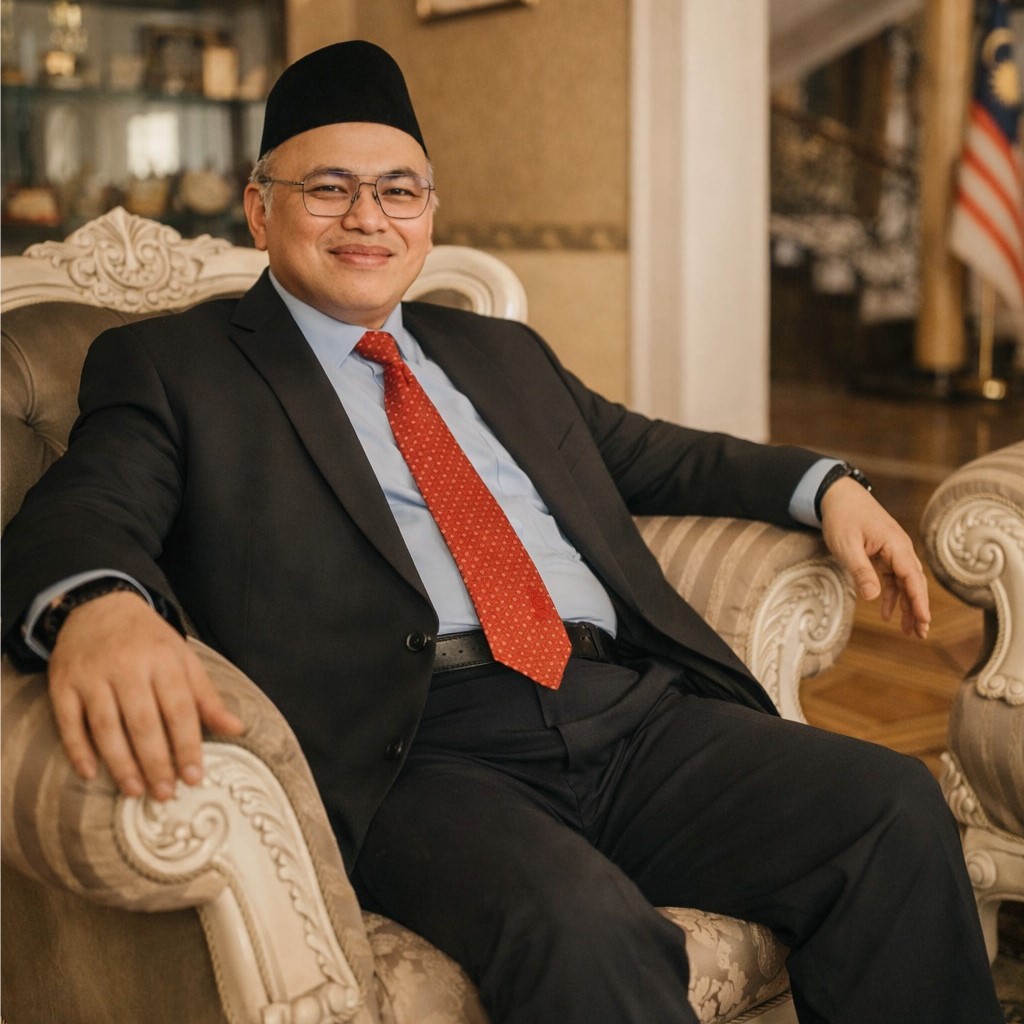
As history seems to whisper from the blue domes of Central Asia, DMDI Magazine was granted a rare and valuable opportunity: to sit in conversation with the Ambassador of Malaysia to Tashkent, Ilham Tuah Ilias. The meeting was not merely an interview, but a dialogue of souls—where diplomatic experience, civilizational memory, and hopes for the future flowed together in a clear and meaningful narrative.
In his carefully chosen words—rich with meaning and wisdom—he did not simply answer questions, but invited readers to walk through the corridors of history, to reconnect with the roots of Islamic civilization, and to envision the future with a broader and more humane perspective. Each sentence was delivered with the composure of a statesman, yet carried the warmth of an educator eager for his nation and the wider Muslim world to rediscover their true identity.
This piece brings together his reflections, presented with a coherent structure of thought, gentle language, and profound vision—allowing us not only to understand, but to truly feel. It is a narrative not only worthy of reading, but of contemplation; one that does not merely inform, but awakens awareness.
History, however, has not always moved gently. Decades under the shadow of communism left Uzbek society distanced from the religious practices that once shaped the rhythm of their daily lives. The call to prayer that once echoed in the air, the Qur’an once read within family spaces, and acts of worship that once formed the pulse of life—gradually faded under the weight of strict ideological control. According to him, the impact of Soviet-era indoctrination went beyond restricting religious practice; it also shaped the mindset and spiritual sensibilities of generations born in that period.
It is here that the role of human connection becomes essential. Not through grand rhetoric, but through the subtle touch of people-to-people contact—youth engagement, cultural exchange, intellectual dialogue, and bonds of brotherhood between communities. Ilham Tuah believes that restoring religious spirit is not merely about returning to acts of worship, but also a path toward inner healing for a society once separated from its roots. From this spiritual restoration, he is confident, will emerge a new generation of researchers, scientists, and young thinkers who inherit the intellectual legacy of their forebears.
Furthermore, he believes that Malaysia–Central Asia relations today do not end in historical nostalgia. The Government of Uzbekistan itself, he noted, is opening wider access for tourists from Malaysia and Indonesia by providing subsidy incentives of around USD 100 through their tourism agencies as a catalyst for visits. For the Ambassador, this is not merely a tourism strategy, but a window of cultural diplomacy—reconnecting two worlds once united by knowledge, faith, and civilization.
For the Ambassador, culture is the most subtle yet most effective language of diplomacy. Between Malaysia and Uzbekistan, there are similarities that hardly require translation—beliefs rooted in Islam, a lifestyle guided by the Sunnah, as well as aligned ecosystems of products and finance such as Islamic banking practices. It is at this point that cultural diplomacy finds its relevance: not merely introducing nations, but reviving awareness of the glory of Islamic civilization that once connected distant regions through knowledge, trade, and refined ways of life. Many have yet to realize that these historical traces still exist, waiting to be rediscovered through a clearer lens.
Through halal food, culinary heritage, Islamic historical sites such as Shah-i-Zinda, and the civilizational narratives of the Arab world and Central Asia, relations between the two countries can be advanced in a more humane form. In an increasingly tense global geopolitical landscape, such gateways of friendship become ever more valuable—they not only open space for collaboration but also restore the spirit of brotherhood among Muslim nations. Cultural diplomacy, in his view, is a quiet yet resilient hope: reconnecting historical memory, nurturing empathy, and igniting a sense of togetherness in an increasingly fragmented world.
 There is a major current already being driven by leaders across various global blocs—a current that can be carefully “ridden” through networks of society and civilization. On one side there is BRICS, on another the Association of Southeast Asian Nations, while across Eurasia stands the Shanghai Cooperation Organisation. All are inhabited by nations with diverse cultural backgrounds, including significant Muslim communities—even among Chinese communities in the Asia-Pacific and mainland Asia. According to him, it is within these spaces that trade, mutual understanding, and soft diplomacy are actively moving, opening opportunities for collaboration that transcend formal political boundaries.
In this context, he envisions global Muslim community networks such as DMDI playing the role of a dynamic connecting node among major blocs like BRICS, the Association of Southeast Asian Nations, and the Shanghai Cooperation Organisation—not to compete with states, but to complement formal diplomacy through branches driven by shared values, history, and civilizational ethics. He added that Central Asian countries hold high regard for the stability, moderation, and progress of ASEAN nations in practicing Islam within modernity. Therefore, such relations should not stop at the trade of goods alone, but must reach deeper civilizational layers: collaboration in the halal ecosystem, Islamic banking, pilgrimage tourism, education, and value-based medical practices rooted in the Sunnah—where ASEAN offers practical experience to share, while Central Asia preserves historical roots and a longing to revive these traditions in a modern form.
On a more practical level, he mentioned commodities such as palm oil as a small yet meaningful example. In Central Asia, chocolate is a symbol of hospitality in homes and official gatherings, and palm oil, he said, enhances the quality of its production. From such seemingly simple matters, culturally attuned trade opportunities can emerge, supported by mutual understanding. For the Ambassador, civilizational diplomacy often begins with the aspects of life closest to everyday human experience.
 Since gaining independence in 1991, the countries of Central Asia have למעשה been undergoing a process of searching for the most suitable expression of Islamic identity for their societies. Various schools of thought, approaches, and examples from across the Muslim world have been observed—like a long social experiment to discover a form of religious life that brings calm rather than unrest. Along this journey, they have witnessed how certain rigid ideologies can give rise to seeds of extremism, which ultimately disrupt social harmony and national stability.
It is this experience, according to him, that has made leaders in the region increasingly cautious in choosing their references. During his assignment in Uzbekistan, and while also being offered coverage in Tajikistan and Kyrgyzstan, he personally observed this tendency. Policymakers there are no longer drawn to rigid and confrontational models, but instead seek examples of Muslim countries that are advanced without losing their moral moderation.
He cited the view of the President of Tajikistan, Emomali Rahmon, who expressed their inclination to emulate progressive and moderate Muslim countries such as Malaysia—a nation that develops steadily through a wasatiyah (moderation) approach. Islam, as practiced, is not merely symbolic, but reflects a balance between development, social stability, and the ethics of communal life. For them, this is the face of Islam that offers hope, not fear.
According to him, Central Asian societies are now choosing the middle path—rejecting polarization and extremism in favor of long-term stability and public well-being, having learned from the unrest in neighboring countries affected by rigid ideologies. At the same time, diplomacy is becoming increasingly personal through tourism: the flow of visitors from Uzbekistan to Malaysia and Southeast Asia is rising, driven by a longing to see the sea, feel the coastal breeze, and enjoy halal cuisine with family—while also sparking interest in educational hubs in Kedah and Langkawi.
However, for him, diplomacy does not end with visits and memories. Meetings between the leaders of both countries open up greater responsibilities: Malaysia should not merely be a destination, but a partner that educates and strengthens capacity. Although the economic balance still leans toward Malaysia, this relationship must be directed so that Central Asian partners can develop their own industries—reviving the intellectual traditions that once flourished in their history.
 He believes that from the seeds of this cooperation, a new generation of Muslim scientists and researchers can emerge—contributing meaningfully to the world in areas such as food technology, medical devices, and innovations that ease human life. Although current statistics may appear modest, high-level visits have opened doors that were previously closed: doors to trade, education, and shared opportunities. From these small openings, a broader future can begin.
In advancing cross-border cooperation, the Ambassador acknowledged an often unseen but crucial factor: mindset. Decades under the Soviet system have shaped certain habits in viewing trade—more administrative than relational. Therefore, when international cooperation is opened, what is needed is not merely agreements, but an expansion of mindset regarding business ethics: that trade requires diligence, mutual understanding, and above all, trust that benefits both parties.
He found that the greatest challenge lies not in opportunities, but in choosing business partners who are genuinely sincere. In any field, there is always a tendency to take advantage if ethical boundaries are weak. Here, he emphasized, religious values can serve as a calming compass—restoring business practices to honesty, transparency, and trustworthiness. The principles taught in the hadiths of Imam Bukhari—whose resting place is near Samarkand—remain highly relevant as moral guidance to revive ethical conduct (adab muamalah) in modern trade.
For him, honoring agreements—from small transactions between sellers and buyers to intergovernmental accords—is the foundation of healthy trade. While remnants of Soviet-era habits may persist, change must be guided through example, patience, and networks of ethically grounded partners to build investor confidence through transparency, integrity, and mutual trust. Ultimately, a trader must also adopt a broader perspective—seeing neighbors in BRICS, the Association of Southeast Asian Nations, and Central Asia as partners on a shared journey—an institutionalized model of mutual support aligned with Islamic values.
 He cited how the Japan International Cooperation Agency, the United States Agency for International Development, and European Union cooperation instruments build influence through funding, training, and technology transfer to developing countries. Meanwhile, many Muslim countries—in Africa, Central Asia, and Southeast Asia—are in fact rich in natural resources: timber, tin, gold, strategic metals, and even rare earth minerals that have become the backbone of the computing and high-tech industries today, particularly in regions such as Tajikistan and Kyrgyzstan.
From this point, he called for what he described as “economic jihad”: not mere rhetoric, but the work of research, scientific collaboration, and joint industrial development. By combining the expertise of Southeast Asian scientists with the resource potential of Central Asia, opportunities emerge to produce agricultural equipment, machinery, and new technologies—even next-generation vehicle engines. For the Ambassador, the future of Islamic cooperation lies not in historical nostalgia, but in the courage to collectively build knowledge and industry for the benefit of the world.
The path of economic cooperation between the MDI network and Southeast Asia, according to the Ambassador, is wide open. What is needed now is a well-structured meeting space—major gatherings that bring together intellectuals, scholars, and academics to offer clear perspectives to leaders that Islam is a religion of peace that upholds human dignity and rights. From these spaces of dialogue, da’wah takes its most authoritative form: correcting narratives about Islam through knowledge, not polemics; through civilizational proof, not rhetoric.
On a practical level, he sees strength in the Islamic financial ecosystem that has matured in Malaysia and Indonesia—supported by waqf, baitulmal, and ethical financing instruments—as seed capital to drive small and medium enterprises (SMEs). For him, the pulse of a nation’s economy is not determined solely by large corporations, but by the ability of its people to do business, set fair prices, and generate income with dignity. Through strengthening SMEs, the gap between the wealthy and the middle-income group can be narrowed, and trade can become more humane and rooted in shared prosperity.
 The Malay world and the Islamic world share a historical destiny to strengthen one another—especially through Southeast Asia as a stable, harmonious region rich in experience in practicing Islam within modernity. In this space, he envisions the role of DMDI expanding through regional branches, reaching out to neighboring countries that share culture and faith, and that possess a young generation that is brave, focused, and proud of their heritage. That DNA of courage, he said, has never disappeared—it was only overshadowed for a time by external ideologies such as communism that obscured part of their historical memory.
He himself feels a deep enthusiasm to help them “rediscover themselves”—to read their history with clarity, and then build the confidence to advance their nation and religion with dignity. From this process of awareness, the network of DMDI countries can share what they have achieved: whether in the form of expertise, moral support, or financial assistance. Cooperation becomes more than agreements; it becomes a living brotherhood.
In terms of resources, he reminded that many countries within this network are endowed with mineral wealth, including gold—a metal that has long been a foundation of value in human civilization. It is not merely a commodity, but a symbol of stability and trust. The Ambassador envisions a future where these traditional values are understood wisely: how natural wealth can be managed justly and ethically for shared prosperity, as exemplified in history.
He also recalled that gold once underpinned the global monetary system—until major changes in the 1970s shifted it to a different foundation. That historical memory, for him, is not mere nostalgia, but a lesson in stability, trust, and how value is constructed in human civilization. In Central Asia today, this legacy finds a renewed echo through the establishment of the Centre of Islamic Civilization in Tashkent, where the famous Uthmanic Mushaf—often referred to as the Samarkand Kufic Quran—is preserved. This heritage connects the past with hopes for the future, especially in cities such as Samarkand and Khiva that are rich with traces of civilization.
According to him, the historical and spiritual strength of this region provides a strong reason for the Malay and Islamic worlds to be present as guiding partners. Countries within the MDI network, he said, should unite in helping Central Asia move along a more balanced path—so that the painful experience of being dominated by external ideologies does not repeat itself in another form. Such assistance is not domination, but a charitable act (amal jariah): restoring self-awareness, civilizational ethics, and practices aligned with the sunnah in social life.
Throughout his two years of service, he has witnessed how cooperation programs with Malaysia have opened real learning opportunities—especially in Islamic banking and the halal ecosystem. The introduction of ethical financial practices and halal standards in food and services has begun to shape a new form for the local economy. For the Ambassador, these small steps gradually but surely build confidence: that civilizational heritage can be revived in a modern, practical, and beneficial form for the future.