
IN THE HISTORIC HEART OF MELAKA,
Ceb Café World History Bookshop:
A Space Of Memory, A Space Of Knowledge, A Space Of Hope

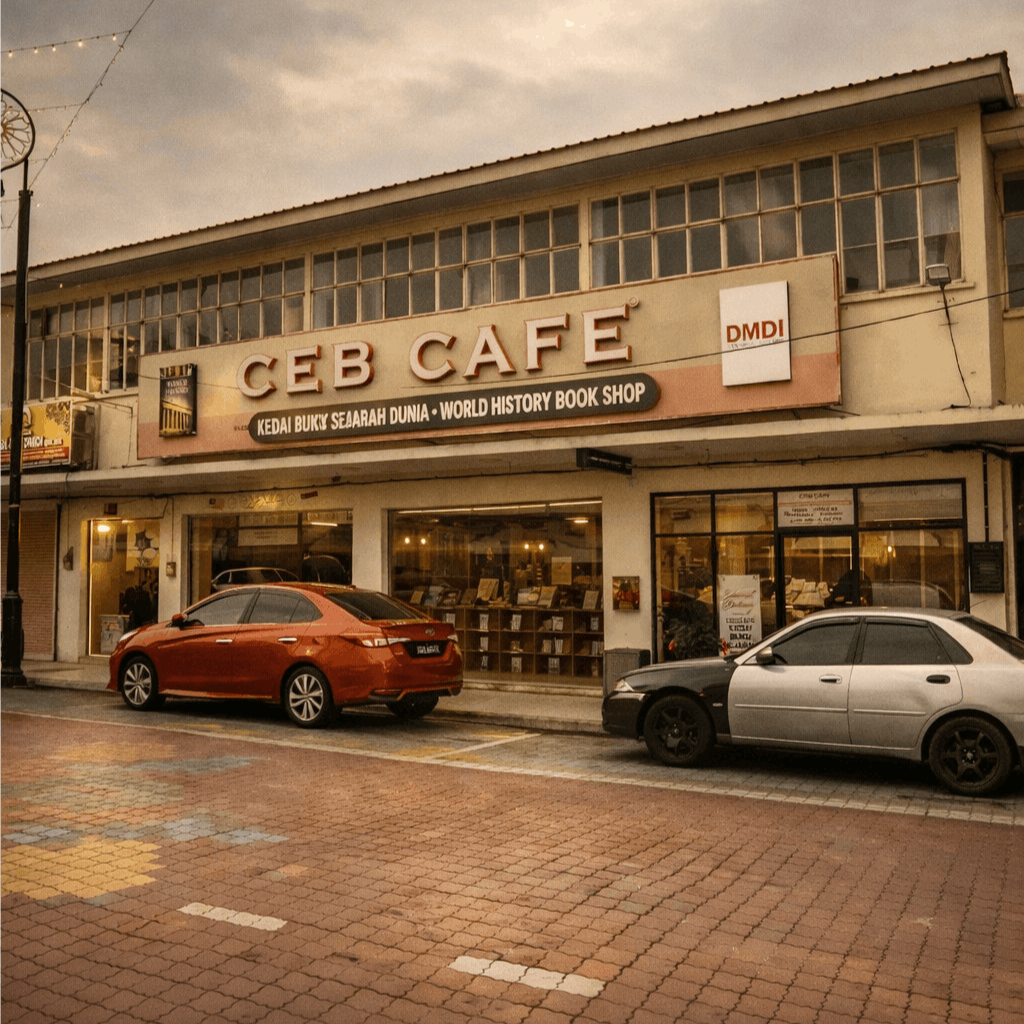
 In the heart of Melaka stands a space that, at first glance, appears simple, yet carries profound meaning. Its name is CEB Café Kedai Buku Sejarah Dunia – World History Bookshop. It is not merely a bookstore, nor just a small café where people stop to unwind. For Tun Seri Ali Rustam, the Yang di-Pertua Negeri of Melaka and President of Dunia Melayu Dunia Islam (DMDI), this place represents a quiet meeting point of memory, knowledge, and aspiration. It is a warm, tranquil space filled with sincerity—where a past once marked by hardship is brought together with a present shaped by hope.
Anyone who steps into CEB Café will immediately sense a different atmosphere. Bookshelves are neatly arranged, filled with titles from across the globe: the history of civilizations, the journeys of nations, great figures, the turbulence of societies, and the evolution of human thought through time. Visitors may browse at leisure, run their fingers along rows of silent yet seemingly expressive books, or sit for hours with a cup of tea or coffee, turning page after page of world history. Through the café windows, the steady flow of tourists from many countries serves as a reminder of the vastness of the world—and that every civilization leaves behind stories to be learned.
In its simplicity, Tun began this initiative with no small measure of determination. CEB Café was officially opened on 1 February 2026 as an open space for anyone who wishes to learn, expand their references, and engage with world history across cultures and eras. Amid his concern over ongoing conflicts in various parts of the world, Tun appears to have envisioned a place of calm—a space where people return to books, retrace the roots of civilization, and learn that the world has fallen time and again when humanity forgets the lessons of history. Thus, CEB is not merely a bookstore, but a signal that knowledge still holds a place as a remedy for the anxieties of our time.
Today, more than a thousand titles fill the shelves of CEB Café, and Tun emphasizes that the collection will continue to grow. He does not want this place to remain a mere symbol. He wants it to live. New books will keep arriving, in line with the aspiration to make this space a small hub connecting people with world history. There is something deeply personal in this commitment—as if Tun is building not just a shop, but a legacy of thought, a quiet home for those who still believe that reading is one of the most meaningful ways to understand the world.

Yet the deepest strength of CEB lies in the history of the building itself. It is not merely an old structure that has withstood the passage of time. It was once a building belonging to Tenaga Nasional Berhad, later acquired by Tun through the DMDI Foundation. But long before it became part of the foundation, before it turned into a world history bookstore, before it was filled with the aroma of coffee and shelves of knowledge, this place had already witnessed Tun’s own youth.
Right at the entrance of the building, at a simple table, he once sat managing the payment counter. Every day after school, Tun would come there to work, helping at the billing counter. Electricity bills were paid there. People came and went, bringing their statements, handing over money, making payments, and then leaving. Amid the sound of footsteps, papers changing hands, and numbers being carefully calculated, a young man was quietly learning about work, responsibility, and hope—slowly growing in silence.
This was long before titles, before his name became widely known, even before life had fully taken shape as it has today. He was still very young—just out of school, not yet fully stepping into the wider world. Those years, around the late 1960s to early 1970s, were a season when life promised little beyond the necessity to endure. Yet it was in that seemingly modest place that the character of a hardworking individual was formed. For Tun, this building is not just an old address. It is the ground where discipline was first planted, where patience was first tested, and where belief in the future began to grow—even before it had a name.
 The grand vision of CEB did not emerge overnight. The idea had long been kept within, like a seed lying dormant in the soil, waiting for the right season to grow. Tun admitted that the concept had existed for years, but it was only around 2013 that the steps to bring it to life slowly began. Not with great fanfare, nor with complete certainty free from doubt. Courage walked hand in hand with hesitation; hope grew little by little. It started simply—try first, build first—who knows, people might come; who knows, the place might come alive. For often, the greatest things in human life begin with a very simple question: is there hope here?
And indeed, that hope exists. Today, people come not merely to buy books. They come to pause, to read, to engage in conversation, to reflect, and to give new meaning to a space once so closely tied to the hard work of youth. Some sit quietly, tracing the history of world civilizations. Others sip tea while gazing out the window. Some open books about great figures of the past, as if searching for answers to present uncertainties in the experiences of those who came before. CEB has become something more than a building—it has become a space where the past and the future meet and shake hands.
Perhaps that is why CEB holds such deep meaning for Tun Seri Ali Rustam. It is not only the place where he first worked, but also where life unfolded in a subtle and meaningful way. From a small table at the entrance to the grand shelves of world history that now stand with dignity, CEB is proof that the human journey is rarely linear—and is, in fact, beautiful precisely because it brings one back to their starting point. Not to relive the past, but to honor it.
At CEB Café Kedai Buku Sejarah Dunia, history is not merely placed on shelves. It lives within the building, within its memory, and within the aspirations that sustain it. And there, among books, coffee, and windows that look out onto the world, one can feel that some spaces in life are not built solely for profit, but to preserve meaning in a world that moves far too fast.